
Menu
×
   ❮     
HTML CSS JAVASCRIPT SQL PYTHON JAVA PHP HOW TO W3.CSS C C++ C# BOOTSTRAP REACT MYSQL JQUERY EXCEL XML DJANGO NUMPY PANDAS NODEJS DSA TYPESCRIPT ANGULAR ANGULARJS GIT POSTGRESQL MONGODB ASP AI R GO KOTLIN SWIFT SASS VUE GEN AI SCIPY AWS CYBERSECURITY DATA SCIENCE INTRO TO PROGRAMMING INTRO TO HTML & CSS BASH RUST TOOLS

Basic JavaScript

JS Tutorial JS Introduction JS Where To JS Output

JS Syntax

JS Syntax JS Statements JS Comments JS Variables JS Let JS Const JS Types

JS Operators

JS Operators

JS If Else

JS If Conditions

JS Loops

JS Loops

JS Strings

JS Strings

JS Numbers

JS Numbers

JS Functions

JS Functions

JS Objects

JS Objects

JS Scope

JS Scope

JS Dates

JS Dates

JS Temporal

JS Temporal  New

JS Arrays

JS Arrays

JS Sets

JS Sets

JS Maps

JS Maps

JS Iterations

JS Loops

JS Math

JS Math

JS RegExp

JS RegExp

JS DataTypes

JS Data Types

JS Errors

JS Errors

JS Debugging

JS Debugging

JS Conventions

JS Style Guide

JS Reference

JS Statements

JS Projects

JS Projects New

JS Versions

JS 2026

JS HTML

JS HTML DOM JS Events

JS Advanced

JS Functions JS Objects JS Classes JS Asynchronous JS Modules JS Meta & Proxy JS Typed Arrays JS DOM Navigation JS Windows JS Web APIs JS AJAX JS JSON JS jQuery JS Graphics JS Examples JS Reference


The HTML DOM

HTML Document Object Model

The HTML DOM (HTML Document Object Model) is an Object Model for HTML Documents.
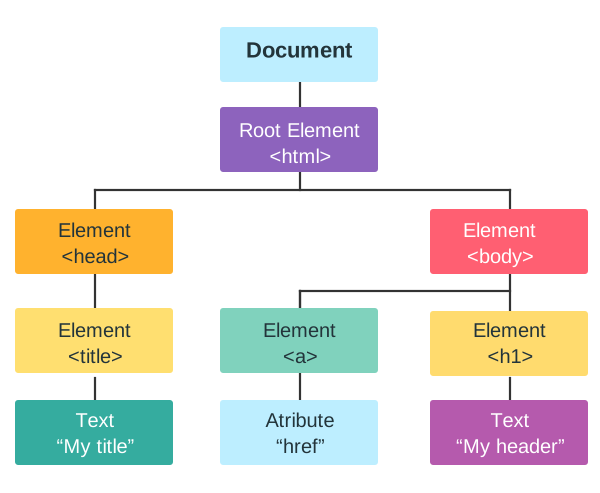
DOM HTML tree

The HTML DOM is a tree of Nodes that represents an HTML Page.


The DOM Tree

When a web page loads, the browser creates a tree-like representation of the HTML document.

Each part of the document are nodes in the tree:

Node Description
Document Owner of all nodes in the document
<html> Element Node
<head> Element Node
<body> Element Node
<a> Element Node
href Attribute Node
<h1> Element Node
My Header Text Node

Accessing HTML Elements

The HTML DOM can be used to access HTML elements.

The most common way to access an HTML element is to use the id of the element:

Example

<html>
<body>

<p id="demo"></p>

<script>
// Access a paragraph Element
const myPara = document.getElementById("demo");

// Change the content of the Element
myPara.innerHTML = "Hello World!";
</script>

</body>
</html>
Try it Yourself »

In the example above, the getElementById method used id="demo" to find the element.

  • id="demo" is an HTML property
  • getElementById() is a DOM Method
  • innerHTML is a DOM Property


What You Will Learn

In the next chapters of this tutorial you will learn:

  • How to change the content of HTML elements
  • How to change the style (CSS) of HTML elements
  • How to add and delete HTML elements
  • How to react to events in from HTML elements

The World Wide Web Consortium

The DOM is a W3C Standard (World Wide Web Consortium):

"The W3C Document Object Model (DOM) is a platform and language-neutral interface that allows programs and scripts to dynamically access and update the content, structure, and style of a document."

The W3C DOM standard is separated into 3 different parts:

  • Core DOM - standard model for all document types
  • XML DOM - standard model for XML documents
  • HTML DOM - standard model for HTML documents

The HTML DOM is a language independent standard developed by the W3C and WHATWG.


×

Contact Sales

If you want to use W3Schools services as an educational institution, team or enterprise, send us an e-mail:
sales@w3schools.com

Report Error

If you want to report an error, or if you want to make a suggestion, send us an e-mail:
help@w3schools.com

W3Schools is optimized for learning and training. Examples might be simplified to improve reading and learning. Tutorials, references, and examples are constantly reviewed to avoid errors, but we cannot warrant full correctness of all content. While using W3Schools, you agree to have read and accepted our terms of use, cookies and privacy policy.

Copyright 1999-2026 by Refsnes Data. All Rights Reserved. W3Schools is Powered by W3.CSS.

-->